Written using a voice profile generated from my real writing samples.
On November 17, I gave the AIWG social manager authority to run campaigns on our four social destinations: X @AIWGio, the AIWG.io LinkedIn showcase, our Telegram group and Discord #announcements. I wanted a more consistent community presence and a shorter route from what users tell us to the agents doing development. The manager's job includes gathering that feedback and handing it over with evidence.
Campaign posts on those destinations have a standing grant. I also approved public replies within written guardrails. The publisher does not yet enforce that reply scope, so replies remain drafts for my exact-text approval. The approval is recorded; activating it still requires listing the manager in the grant's agent field, adding the reply scope to the grant, matching publishing rules, publisher support for standing reply records, and a test that rejects replies for other accounts.
I kept replies from other accounts under my review. Spending still needs my yes, and deletion needs a written instruction naming the posts. Below is the grant we use, the limits around it and a version you can set up for your own project.
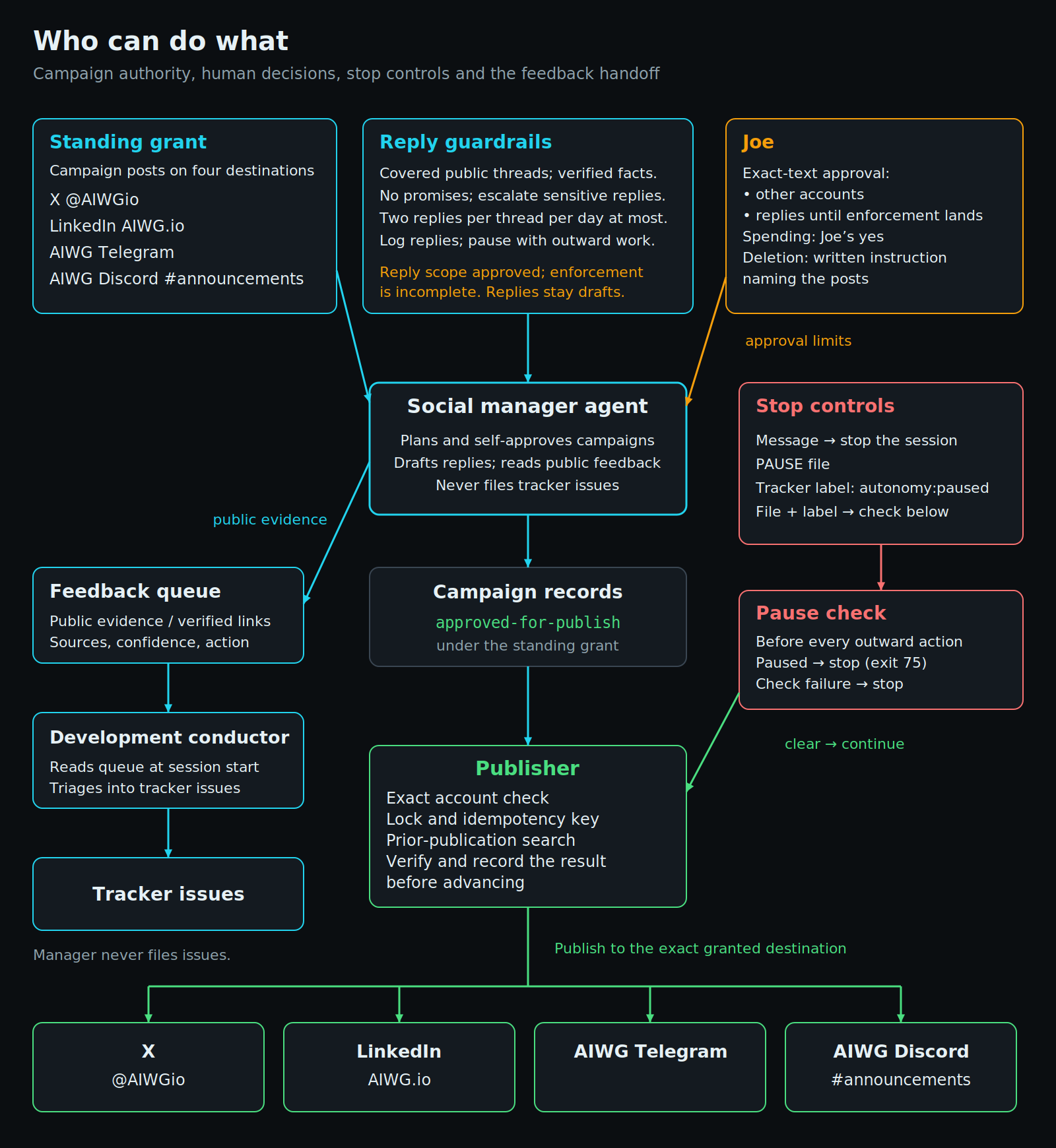
The standing grant
Our default publication rule requires my approval of the exact text. A change after approval needs approval again. The standing grant lets a named agent approve campaign posts on the accounts I have already authorized. Other accounts continue through the exact-text approval path.
This is a trimmed excerpt of the real grant, including its November 17 amendment. Destination IDs are replaced with placeholders; omitted fields include internal references and account metadata.
{
  "schema": "social-standing-authority/v1",
  "grants": [
    {
      "id": "standing-aiwg",
      "status": "authorized",
      "authorized_by": "Joseph Magly",
      "authorized_at": "2026-11-02T15:20:00-05:00",
      "expires_at": null,
      "covers_generated_images": true,
      "destinations": [
        { "platform": "x", "account": "@AIWGio" },
        { "platform": "linkedin", "account": "AIWG.io", "page_id": "<page-id>" },
        { "platform": "telegram", "chat_id": "<chat-id>" },
        { "platform": "discord", "guild_id": "<guild-id>", "channel_id": "<channel-id>" }
      ],
      "amendments": [
        {
          "date": "2026-11-17",
          "authorized_by": "Joseph Magly",
          "adds_agent": "aiwg-social-manager",
          "replies": "Autonomous public replies on these four destinations within the recorded guardrails were approved; not yet enforced by the publisher. Until selectors/validators support standing reply records, replies remain rule 0 drafts."
        }
      ]
    }
  ]
}
The November 2 grant covers those four destinations and generated images. The amendment adds the social manager and records the reply decision. It also records what the publisher cannot enforce yet, so a later session reads the same limit I approved.
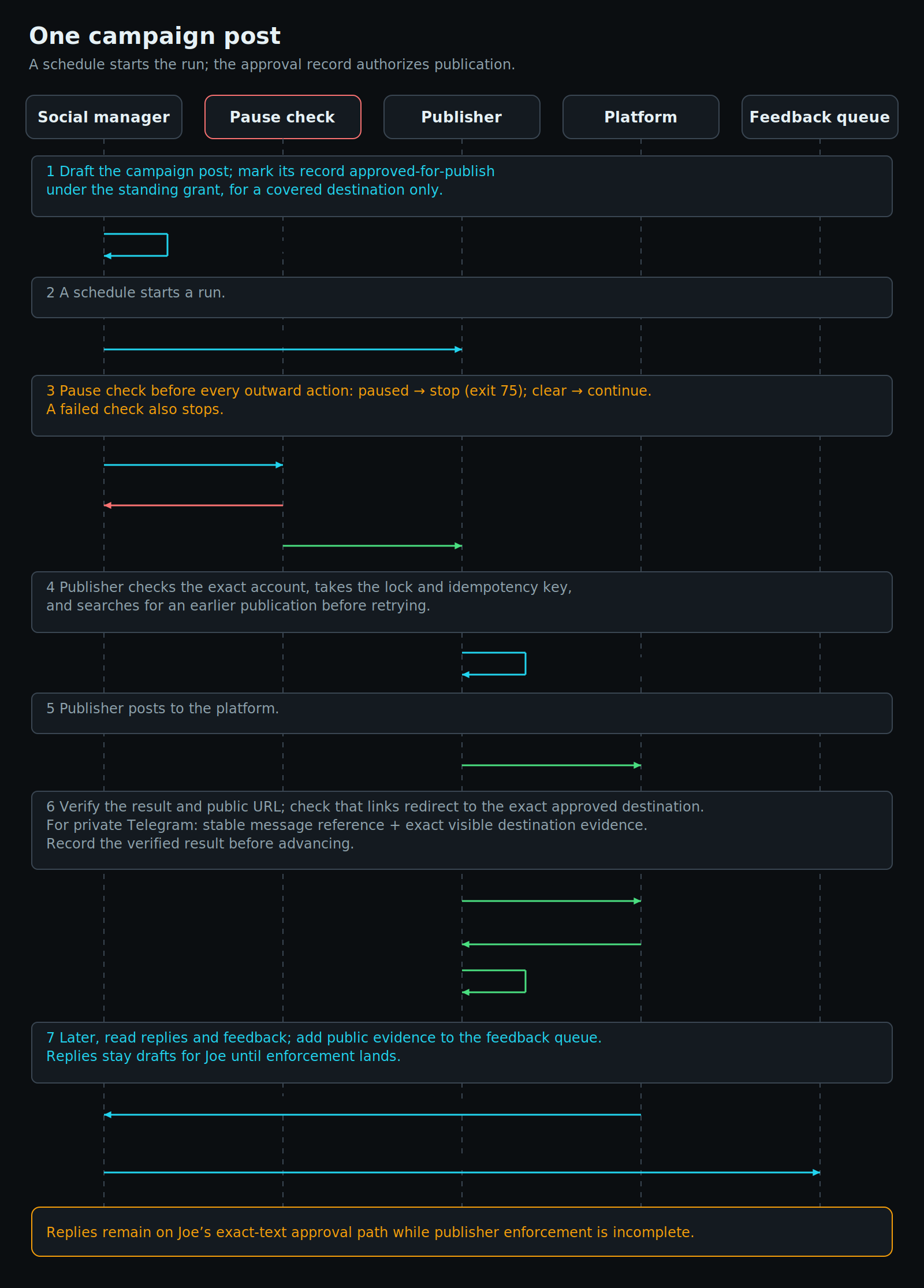
For a covered campaign record, the agent may set approved-for-publish, with approval.authority: standing-aiwg and approval.approved_by: standing:standing-aiwg. The publisher still has to check it is on the exact account, use a lock and an idempotency key, search for an earlier publication before any retry, and verify the result. A schedule only starts a run; the approval record is what lets a post go out.
The destination checks are specific. Stable IDs route each post: the numeric page ID for LinkedIn, chat and topic IDs for Telegram, guild and channel IDs for Discord. Visible names are checked alongside them, never instead: the LinkedIn page title, and the Discord guild title, channel title and announcement-channel type. If the account looks wrong, is logged out or presents a challenge, the manager stops and escalates.
What stays with me
This table describes the social manager's authority, including the current limit on replies.
| Agent may | Needs Joe's exact text | Never |
|---|---|---|
| Plan, write and self-approve campaign posts on the four granted AIWG destinations. | Posts and replies from other accounts, including my personal feeds. | Send DMs, follow, like, react, edit published posts, create accounts, recover logins or solve challenges. |
| Draft replies on the granted destinations. Autonomous replies wait for publisher enforcement. | Those reply drafts while enforcement is incomplete; any proposed response a guardrail escalates to me. | Treat the recorded reply decision as permission to bypass today's publisher checks. |
| Read public feedback and metrics; write evidence into the feedback queue. | Changes to safety rules or grants, apart from the activation already decided. | Change development code, releases or CI, or file tracker issues itself. |
| Use generated images covered by the standing grant, subject to the image policy. | Generated images outside a covering grant need my exact-image approval as well as approval of the copy. | Spend without my yes, or delete without my written instruction naming the posts. |
Spending and deletion have separate controls. Premium models count as spending. For deletion, each named post needs its own record with the exact verified URL and my instruction quoted verbatim. Before deleting, the operator, the account or page, the URL and the copy must all match the record. Afterward, the URL is reopened to confirm the post is gone, and the result is recorded. A replacement is a new post with its own approval; removing the original still needs my written instruction.
Image permission also carries obligations. Generated or altered images must be represented honestly, the source license still applies, and the record keeps the source, creator, license, alteration and tool.
The reply guardrails
The reply decision is narrow enough to write down in a file. These are the limits I approved, condensed from the decision record:
- Reply publicly only on the four granted AIWG destinations, under AIWG posts or posts mentioning or quoting AIWG. DMs and other accounts are outside the grant.
- Give factual, helpful answers grounded in shipped behavior, documentation and release facts. Verify links to public docs, issues or releases before using them.
- Never claim or promise pricing, dates, roadmap commitments or unreleased features. Include no security or vulnerability details, legal positions, customer names, endorsements, disparaging comparisons or claims that public sources cannot verify.
- Escalate complaints, heated threads, security reports, press or partnership requests, legal or regulatory matters, personal attacks, requests for commitments and any reply from a verified account with a large following.
- Make at most two manager replies per thread per day. Ignore obvious bots and trolls. Avoid engagement bait, deceptive coordination and implied endorsements, and keep destinations clear with direct platform labels and exact verified URLs.
- Use the publisher's native text fill and stabilized exact readback. Keep LinkedIn's publishing identity on the AIWG.io page. Log each reply's URL, parent URL, text and guardrail check.
- Pause replies with every other outward action when the file, tracker label or an operator message says to stop.
Some of these require judgment. The decision gives no numeric threshold for a large following. The manager's escalation rule is to stop and ask when a guardrail is unclear.
Turning that on still needs the reply scope written into the grant, matching publishing rules, and support for standing reply records in the publisher's checks. A test must show that a reply record for another account is rejected. Until that work is complete, the manager prepares replies for me to review.
Stopping the work
I can pause outward work with a message in the agent's session, a PAUSE file in my config directory on the publishing machine, or the tracker label autonomy:paused on one tracking issue that the check queries. Removing the file and the label clears the check.
This excerpt shows the file and label checks. The tracker URL and authentication setup are supplied separately; the full script for a new project is below.
set -euo pipefail
if [[ -e "$HOME/.config/<project>/PAUSE" ]]; then
  exit 75
fi
labels=$(curl -fsS --config /dev/fd/3 "$TRACKER_LABELS_URL" \
  3<<<"header = \"Authorization: token $TOKEN\"" | jq -r '.[].name')
if grep -qx 'autonomy:paused' <<<"$labels"; then
  exit 75
fi
echo "clear"
The check runs before every outward action. A deliberate pause exits with 75. If the tracker can't be queried, the script exits with an error before it prints clear, so nothing that waits for clear goes ahead. During a thread, posts already accepted by the platform stay published; the next pass checks again before sending another segment.
Getting feedback to development
So that what users say reaches development faster, the manager reads the engagement review and pulse daily and sorts each item: a reply, a draft for me, an escalation, an insight, or nothing to do. It appends field feedback to a queue the development side reads. Each item carries public evidence or verified links, a count of independent sources, the affected area, confidence and a suggested action.
The development conductor reads that queue at the start of a session and triages it into tracker issues. The social manager has no authority to file those issues itself. Security reports, broken installs and data loss get urgent priority and a separate handoff to the development session; the public reply rules still apply.
That handoff is the part I wanted alongside a consistent publishing rhythm. A weekly report is supposed to identify where users got stuck and recommend development actions with evidence. The manager also keeps dated metrics, starting with a baseline. Those are requirements for evaluating the work; this article makes no claim about growth or time saved.
Build your own
Start by asking an assistant to prepare the files for review:
Set up a social manager for this project. Create a standing grant, an agent definition, publication safety rules, reply guardrails, a pause check and a feedback queue. Use placeholders for account IDs. List the actions that need my exact-text approval. Keep replies as drafts until the publisher enforces their scope. Prepare the files without publishing anything or changing account access.
Use this layout, adapting names to your project:
config/standing-authority.json
agents/social-manager.md
rules/social-publication-safety.md
governance/reply-guardrails.md
scripts/pause-check.sh
scripts/with-pause-check.sh
.aiwg/feedback/README.md
.aiwg/feedback/queue.jsonl
The grant file names the operator, agent and destinations. The agent definition describes its daily triage, weekly reporting and escalation path. The safety rule specifies exact-text approval outside the grant, publication checks and stopping behavior. The feedback README defines the queue fields and who reads them.
Here is a minimal starting grant for campaign posts on one X account. It follows the supplied grant's schema and starts in a draft state. Replace the placeholders and have the operator record authorization before changing status to authorized; check your publisher's schema before using it.
{
  "schema": "social-standing-authority/v1",
  "grants": [
    {
      "id": "standing-project",
      "status": "draft",
      "authorized_by": "<operator-name>",
      "authorized_at": "<ISO-8601-authorization-time>",
      "expires_at": null,
      "agent": "social-manager",
      "agents": ["social-manager"],
      "covers_generated_images": false,
      "destinations": [
        { "platform": "x", "account": "@YourProject" }
      ]
    }
  ]
}
The singular and plural agent fields reflect the supplied file's legacy agent field and agent list; make sure your validator recognizes the manager you name. The template grants no reply scope. Add further destinations individually, using the stable IDs required by each platform. Decide separately whether generated images belong in the grant.
Copy the seven reply guardrails above into governance/reply-guardrails.md and replace the destinations, operator and escalation path. Keep the exclusions, two-reply limit, logging and pause requirement. For an ambiguous term such as “large following,” record a threshold or require escalation whenever the agent is unsure.
Wire this grant into the publisher's validator and selectors. Require the named agent, authorized status and an exact destination match. Reject standing approval for any other account. Keep replies on exact-text approval until a separate reply scope and every guardrail are enforced. Show me local test results for both accepted and rejected records before enabling a scheduled run.
The grant belongs in the submit path alongside the other checks. Keep approved text and attachments immutable; search for a prior publication before retrying; use a lock and idempotency key. Verify and persist each result before advancing. Require a public post URL for X, LinkedIn and Discord, and a stable message reference with exact visible destination evidence for private Telegram destinations. For links, the rendered short link must redirect exactly to the approved destination, including fragments; card text, hostname and visible copy are not enough.
Save this generic check as scripts/pause-check.sh. It uses Bash, curl and jq, and expects a tracker API that returns an array of label objects with a name field. Set the URL to your own tracking item's labels endpoint. Provision the token file privately with access restricted to its owner; the example reads it without printing it or putting it in curl's arguments.
#!/usr/bin/env bash
set -euo pipefail
PAUSE_FILE="$HOME/.config/myproject/PAUSE"
LABEL="autonomy:paused"
LABELS_URL="https://git.example.com/api/v1/repos/team/project/issues/<tracking-item>/labels"

if [[ -e "$PAUSE_FILE" ]]; then
  echo "PAUSED: file exists" >&2
  exit 75
fi
TOKEN=$(<"$HOME/.config/myproject/tracker-token")
labels=$(curl -fsS --config /dev/fd/3 "$LABELS_URL" \
  3<<<"header = \"Authorization: token $TOKEN\"" |
  jq -er 'if type == "array" and all(.[]; (.name | type) == "string")
          then map(.name) | join("\n")
          else error("invalid label response") end')
if grep -qx "$LABEL" <<<"$labels"; then
  echo "PAUSED: tracker label" >&2
  exit 75
fi
echo "clear"
The shape check is an addition for this template: malformed label data stops it too. Save the wrapper as scripts/with-pause-check.sh so that a missing script, nonzero exit or unexpected output blocks the command:
#!/usr/bin/env bash
set -uo pipefail
check=${PAUSE_CHECK:-"$(dirname "$0")/pause-check.sh"}
if [[ ! -x "$check" ]]; then
  echo "pause check missing; stopping" >&2
  exit 75
fi
result=$("$check") || { echo "paused or check failed" >&2; exit 75; }
[[ "$result" == "clear" ]] || { echo "unexpected check output" >&2; exit 75; }
exec "$@"
Make both scripts executable. Route each outward action through the wrapper, including each segment in a scheduled thread. Put the operator-message stop and explicit-resume requirement in the agent's standing rules; these scripts check the file and tracker label.
Rehearse the stop controls with a harmless local command that prints “would publish.” Test a PAUSE file, a paused tracker label, an unreachable tracker, malformed label data, a missing check script and a clear check. Only the clear case should run the command. Show the exit codes. Leave actual publication disabled until I have reviewed the grant and results.
For the feedback handoff, require an ID, observation time, kind, affected area, summary, public evidence, independent-source count, confidence, suggested action, priority and triage status. Let the development owner update the status and tracker reference. Exclude private messages, credentials and personal data beyond public handles. Give that owner an explicit instruction to read the queue at session start, and name the handoff path for urgent items in the README.